
Every Object Holds a Story

"Touch something long enough and it will tell you its secrets, not in words, but in feeling, in flashes, in the quiet language of energy."

The World Your Hands Already Know
Imagine picking up a stranger's old pocket watch and suddenly feeling a wave of deep sadness wash over you, not your own, but someone else's. A rush of warmth follows, then a vision of a man in a garden at dusk, laughing. You set the watch down. The feeling fades. But what just happened?
That, in its most natural and unguarded form, is psychometry. It is the ability to perceive the emotional, energetic, and historical impressions stored within physical objects... to read an object the way a skilled reader reads a page. And while it may sound like the stuff of séance parlors and gothic novels, psychometry is one of the most widely practiced, teachable, and genuinely accessible forms of psychic development available today.
Whether you are brand new to intuitive work or have been developing your gifts for years, understanding psychometry opens a doorway into a world where everything around you is quietly speaking, and all you need to do is learn how to listen.

A Gift With a Name: The History of Psychometry
The word "psychometry" was coined in 1842 by American physician and professor Joseph Rodes Buchanan, who was fascinated by reports of students who could identify unlabeled medicines simply by holding their containers. Buchanan called the phenomenon soul-measuring, a term derived from the Greek words psyche (soul) and metron (measure). He believed that all objects possessed a nerve aura capable of conveying information to a sensitive person.
Shortly after, geologist William Denton took Buchanan's ideas further by experimenting with geological specimens. He blindfolded subjects, including his own sister, and had them hold rock samples wrapped in cloth. To his astonishment, they reported vivid scenes from the earth's prehistoric past. Denton documented his findings in his 1863 work The Soul of Things, where he proposed that every object is essentially a recording device, imprinted with the energetic residue of everything it has encountered.
While mainstream science largely moved on from these early experiments, the practice of psychometry flourished within spiritualist and metaphysical communities, and the core idea has never really left: matter holds memory.
How Does It Work?
To understand psychometry, it helps to shift how you think about the physical world. In conventional thinking, an object is simply matter, atoms arranged in form. But energetically speaking, everything that has ever been loved, worn, worried over, cherished, or mourned leaves an impression on the world around it. Emotion is not contained purely within the body. It radiates outward, and it settles.
Think of an object like a sponge. Over time, it absorbs the emotional frequencies of the people who handle it, their joy, grief, anxiety, passion, boredom, love. These impressions do not disappear when the moment passes. They linger, layered one upon another, like sediment at the bottom of a lake. A psychometrist is someone who has learned, or is naturally inclined, to reach into that lake and feel what lies there.
The information received through psychometry is rarely linear or encyclopedic. It arrives in impressions, emotional tones, symbolic imagery, physical sensations, sudden knowing, or even sounds and smells. The language of energy is the language of the senses, filtered through your own unique psychic style.

A note on science: Quantum physics has introduced fascinating concepts like morphic fields (proposed by biologist Rupert Sheldrake) and the idea that energy cannot be destroyed, only transformed. While psychometry remains outside the scope of mainstream scientific consensus, it aligns philosophically with the understanding that energy is relational and that matter is far more dynamic than it appears on the surface.
The information received through psychometry is rarely linear or encyclopedic. It arrives in impressions, emotional tones, symbolic imagery, physical sensations, sudden knowing, or even sounds and smells. The language of energy is the language of the senses, filtered through your own unique psychic style.
How the Information Arrives: Your Psychic Senses in Action
No two psychometrists receive information in exactly the same way. How the impressions come to you depends largely on which of your psychic senses or "clairs", is most developed. Understanding this helps you interpret what you receive with greater confidence.
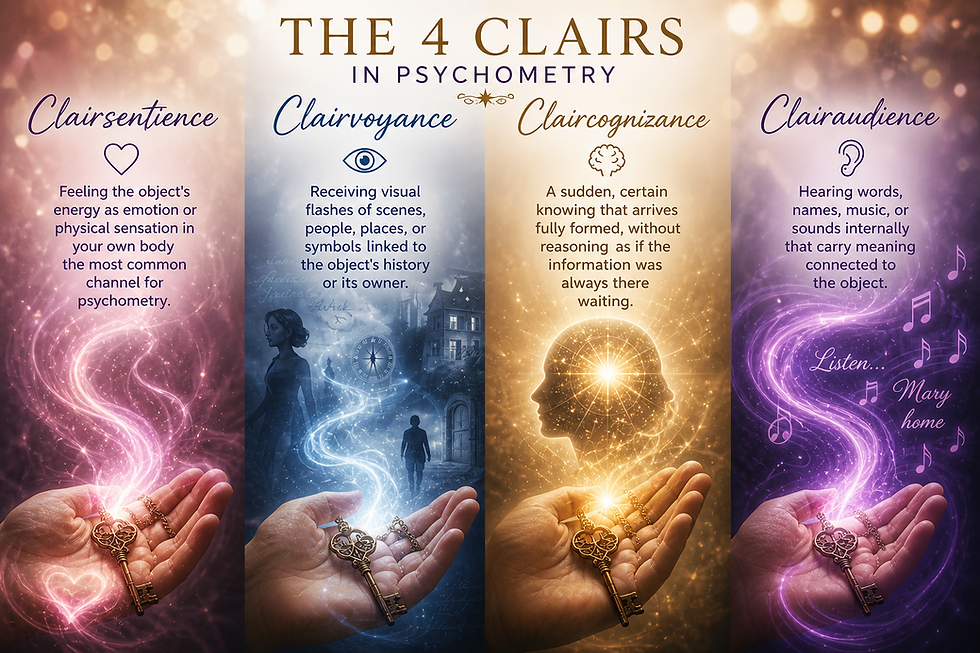
Most people find that one or two of these channels dominate, at least at first. With practice, the channels open more fully and the impressions become richer and more layered. Trust is the key, not performing, not analyzing, but simply receiving.
How to Practice Psychometry: A Step-by-Step Approach
One of the most beautiful things about psychometry is how tangible and immediate it is. You do not need to be deeply experienced to feel something. You simply need to slow down, open up, and trust the first things that come.
Choose the right object: Start with something personal - a piece of jewellery, a watch, a small keepsake, that has been owned and worn by one person for a significant period. The longer an object has been in close contact with someone, the stronger and clearer the impressions tend to be. Avoid objects that have passed through many unknown hands, such as antique market finds, when you are just beginning.
Ground and centre yourself first: Sit quietly, breathe deeply, and release the chatter of the day. Psychometry works best when you are calm and present. A few minutes of mindful breathing or a grounding visualisation, imagining roots growing from your feet into the earth, creates the internal stillness needed to perceive subtle energies.
Hold the object gently and close your eyes: Cup the object in your non-dominant hand, or hold it between both hands. The non-dominant hand is traditionally considered more receptive and is often more sensitive to incoming energy. Do not grip, hold the object with the same softness you would use to cradle a small bird.
Notice the very first impression: Before your analytical mind wakes up and starts offering logical explanations, what arrives? A colour? A feeling in your chest? A word? A smell? A scene? The first impression is almost always the truest. Do not dismiss it because it seems strange or disconnected, report it exactly as it comes.
Follow the thread without forcing: Once you have your first impression, you can gently follow it. Ask internally, "What else is here?" and wait. Do not push. Do not manufacture. Simply stay open and observe what surfaces. Some sessions are rich and layered; others are quieter. Both are valid.
Record everything, then validate: Speak your impressions aloud or write them down as they come, without filtering. Once you have finished, compare notes with the object's owner. You may be surprised by what resonates and what confirms that the information was real, not imagined.
Which Objects Speak the Loudest?
Not all objects carry impressions with equal clarity. As a general guide, the more personal and the longer an object has been worn or handled by one person, the more energetically saturated it tends to be.
Jewelry... especially rings and watches: These are the classic objects of psychometry for good reason. A wedding ring worn daily for forty years is saturated with decades of emotional life, e.g. love, worry, grief, celebration. The metal holds it all. Rings in particular, worn so close to the pulse point of the wrist, are extraordinarily potent starting points.
Clothing... particularly items worn during significant moments: A garment worn during a wedding, a battle, a birth, or a moment of deep grief carries an emotional charge that is often palpable. Old military uniforms, for instance, tend to carry very strong, sometimes overwhelming impressions and are best approached with energetic protection in place.
Handwritten letters and photographs: The act of writing by hand is deeply personal... it is an extension of the body and the mind simultaneously. Old letters and handwritten notes carry the energetic signature of their author in a particularly clear way. Photographs, meanwhile, can act as a bridge not only to the object itself but to the person depicted within it.

Keys: Keys are fascinating psychometric objects because they carry the energy of both the person who held them and the spaces they unlocked, e.g. homes, cars, places of work, sacred rooms. They hold layered stories within their small, worn forms.
Common Challenges
Nearly every developing psychometrist encounters the same early obstacles. Knowing what they are does not make them disappear immediately, but it does make them far less discouraging.
The overthinking trap: The single greatest barrier to psychometry is the analytical mind. The moment you begin questioning whether what you are receiving is real, you create interference. Think of it like trying to hear someone speak while simultaneously critiquing their accent... you will struggle to do both at once. The skill of psychometry is the skill of stepping out of your own way. Practice staying in observation mode rather than evaluation mode, at least during the reading itself.

Confusing your own emotions with the object's impressions: If you are carrying strong emotions of your own... stress, grief, excitement, they can bleed into your reading and create confusion. This is why grounding beforehand is not optional; it is essential. Know what you walked into the room with before you pick up the object, so you can recognise what belongs to you and what belongs to the energy you are reading.
Expecting too much, too soon: Some people receive vivid cinematic impressions on their first attempt. Others receive a quiet hum of feeling and a single word. Both are real; both are valid starting points. Psychometry, like any skill, deepens with practice. The impressions that feel thin and tentative at first grow richer, more detailed, and more confident over time. Give yourself permission to be a beginner.
Reading With Integrity: The Ethics of Psychometry
Like all forms of psychic work, psychometry comes with a responsibility to the person whose energy you are reading. The information that arises during a session is personal and sometimes deeply so. It deserves to be handled with the same care and confidentiality you would extend to any intimate disclosure.

Always seek permission before reading an object belonging to someone who is present. Never use psychometry to manipulate, frighten, or claim false authority. And remember: even gifted practitioners are not infallible. Impressions can be filtered through your own beliefs, language, and experiences. Approach your readings with humility, not performance. The most powerful readers are often the quietest ones, the ones who understand that they are a vessel, not the source.
Psychometry at its finest is an act of service and connection... a way of honouring the invisible threads that link us to one another and to the objects that move through our lives carrying pieces of who we have been.
The Object in Your Hand Is Already Speaking
There is something profoundly moving about psychometry, this idea that nothing we have loved simply disappears. That the ordinary objects of a life, a grandmother's brooch, a child's worn pencil case, a letter never sent, are more than matter. They are memory made tangible. They carry within them the fingerprints of the soul.
To practice psychometry is to take seriously the possibility that the world is alive with information and that you are equipped, right now, to begin receiving it. You do not need a perfectly developed gift. You do not need years of training before you begin. You need only an object, a moment of stillness, and the willingness to pay attention to what your hands already know.
The next time you pick up something old and feel that inexplicable pull, that quiet tug that says there is something here, do not brush it off as imagination. Sit with it. Stay with it. Let it speak.
You might be more psychic than you ever believed.
Ready to Develop Your Psychic Gift?
The Intuit Psychic Course takes you from curiosity to confidence, with guided lessons in developing your psychic reading abilities and all four clairs.


Comments